
The panel session explored how Living Lab methodologies can be more systematically embedded in higher education institutions (HEIs), and how their impact can be better assessed and communicated. It addressed challenges such as fragmented implementation, limited institutional integration and the difficulty of demonstrating Living Lab contributions beyond anecdotal evidence.
Moving from individual courses to European University Alliances, the discussion examined how to assess impact across micro, meso, macro and meta levels, from student learning outcomes to policy influence. It also explored the long-term sustainability of solutions, pathways for translating insights into policy and practice, and collaboration between academia, companies and entrepreneurs. The session presented an impact framework and practical cases to illustrate how HEIs can demonstrate the wider value of Living Labs.
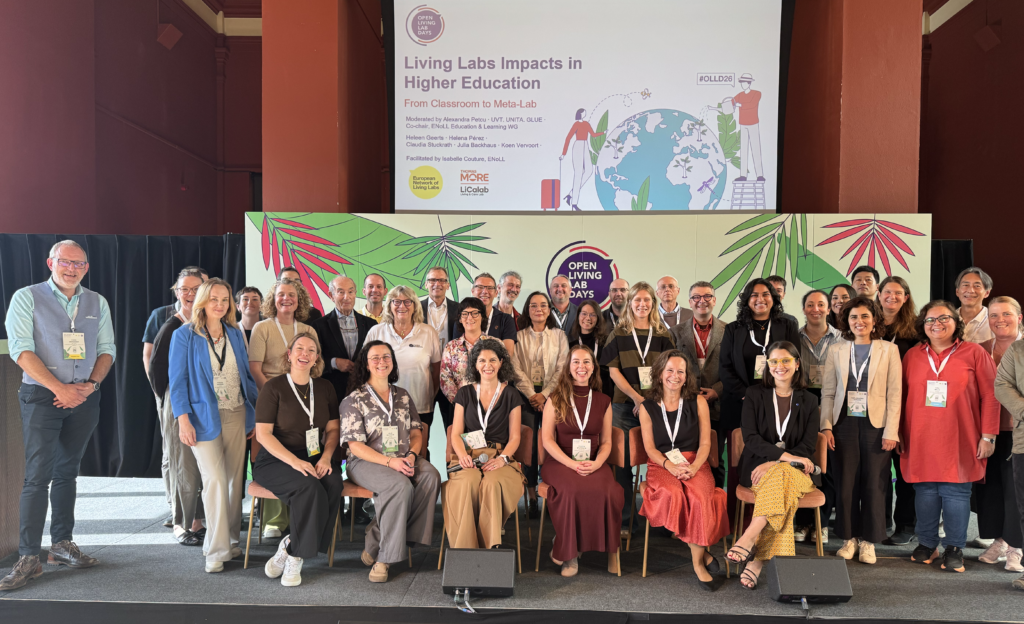
The session was convened and moderated by Alexandra Petcu (West University of Timișoara), co-chair of the ENoLL Education & Learning Working Group, with Isabelle Couture (ENoLL) supporting facilitation and capturing the discussion. It brought together Heleen Geerts (The Hague University of Applied Sciences), Helena Pérez Pérez (CETT – University of Barcelona), Claudia Stuckrath (Utrecht University), Julia Backhaus (RWTH Aachen University) and Koen Vervoort (ENoLL). Rather than five consecutive presentations, the session was built as two short rounds of panel contributions around a fishbowl exchange with the room, so that participants could bring their own measurement experience – including what had not worked – into the discussion before the panel returned to the question of what actually lasts.
The session started from a shared difficulty: higher education institutions are increasingly asked to demonstrate their societal contribution, while the evidence Living Labs generate tends to stay anecdotal – stories that travel well but do not add up. The discussion therefore moved deliberately across four scales: the individual course (micro), the institution (meso), the regional ecosystem (macro) and the European university alliance (meta), asking at each level what can actually be observed and what is only asserted.
Entry points. Heleen Geerts described elective courses as the easiest way to introduce a multi-stakeholder approach to learning, and made the point that learning outcomes should not be reserved for students: other participants learn too. Experiential learning works in hybrid settings, and collaboration is widening from universities of applied sciences towards research universities.
Students as consultants. Helena Pérez Pérez presented the adaptation of the university-hospital model to the hospitality sector, with the university, the students and the hotel as main stakeholders and a win-win-win as the explicit objective – for example, architecture students developing solutions for an underused hotel lobby, with teaching staff ensuring curricular relevance. Scaling, she argued, is adaptation to a new context rather than replication of a model elsewhere.
Orchestration. Claudia Stuckrath traced a five-year path from a course that used the campus as a testing environment to a Living Lab aligned with the university’s strategy, and named orchestration as the often-hidden force that holds activities, stakeholders and initiatives together. It is best built progressively: start with a pilot, build on the first experiences, then connect with the similar activities already running elsewhere on campus. Coordination is needed both inside the Living Lab and between the Lab and its wider ecosystem.
Institutional entrepreneurship. Julia Backhaus took the discussion from individual Living Lab projects to a university Living Lab and on to university alliances. RWTH Aachen’s Living Labs Incubator, part of the university’s Excellence strategy, has been active since 2021 and has now secured funding until 2033; a campus Living Lab will be added next year, a sign of increased institutional interest in innovation in research, teaching and organisation. The team understands itself as institutional entrepreneurs, connecting existing activities and opportunities for transformative change within their own institution. Networking has to be paired with mapping and reviewing what already exists – not everything described as a Living Lab meets the criteria of one. At alliance level, partners exchange experiences, map and connect existing practices and look for transferable approaches, while recognising how complex that is.
What is not being measured yet. Koen Vervoort reported from ENoLL’s impact work that measurement at micro and meso level is progressing reasonably well, while the macro level remains a significant gap: as evaluation expands beyond single activities, broader and longer-term effects become harder to capture. His recommendation was to work with Key Value Indicators rather than relying exclusively on traditional KPIs, with ENoLL’s harmonised set of 36 KPIs as a possible starting point.
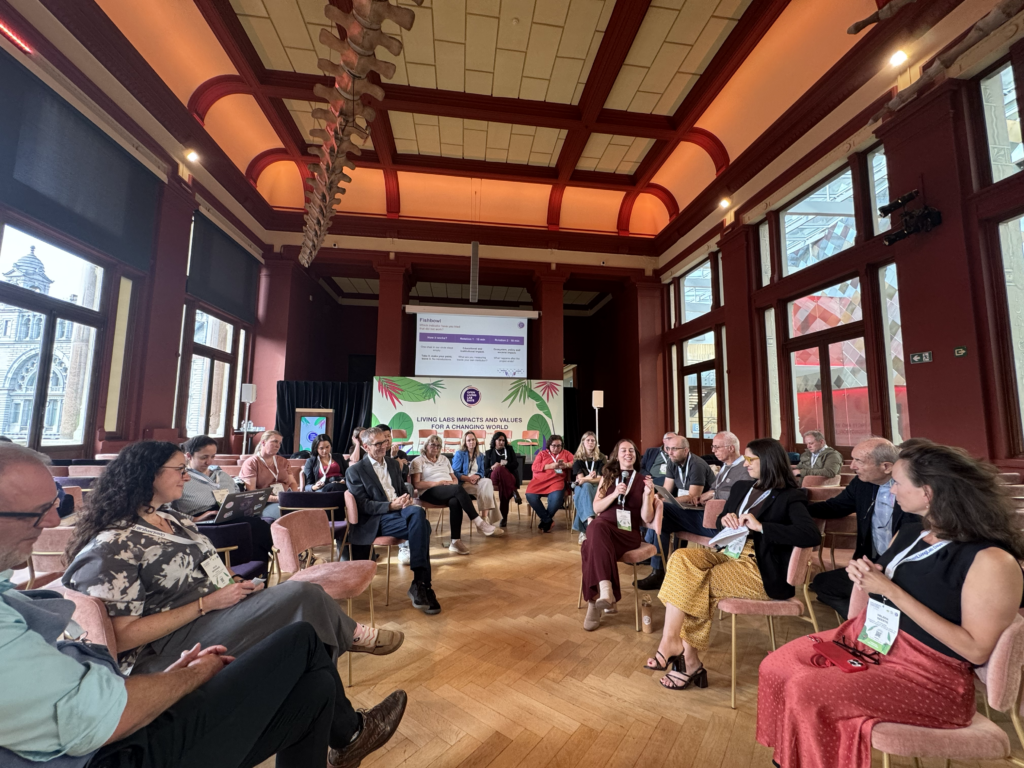
The fishbowl was opened with a deliberately uncomfortable question – which indicator have you tried that did not work? – on the assumption that failures travel further than successes and unblock a quiet room faster. What the room produced can be summarised in seven points.
Contributions from Japan, Australia and Canada kept the discussion honest about context. Funding structures, regulation, ecosystem maturity and institutional and cultural tensions – including those involving Indigenous communities in the Canadian case – shape what a Living Lab can be and what it can reasonably measure. The temporary nature of student participation was named as a structural obstacle to long-term impact: students are only part of the university for a few years, which makes it difficult to move beyond the first layer of outcomes.
Alexandra Petcu, PhD – West University of Timișoara; co-chair, ENoLL Education & Learning Working Group (session organiser and moderator)
Heleen Geerts – The Hague University of Applied Sciences; co-chair, ENoLL Education & Learning Working Group
Session notes: Isabelle Couture – ENoLL
Stay connected and inspired! Subscribe to our newsletter for the latest updates, insights, and innovations from our global community of Living Labs.