Every October, professors at the Jagiellonian University in Kraków put on traditional gowns and march through the city from the university’s oldest buildings, the same halls where Copernicus once studied, to open the new academic year. As they leave, the Collegium Maius clocks ring out, a reminder that each generation of scholars is a small part of a history spanning over six centuries, and that they are there to serve.
It’s a fittingly grand tradition for one of Europe’s oldest universities. And it sits right alongside something that sounds almost like its opposite: a transdisciplinary research centre on the new campus built on the idea that academic prestige is beside the point. “You have to remember that all this prestige of academic work is a kind of coat that you have to take off, put it on the hanger, and join the people sitting at the table on equal grounds,” says Beata Jałocha, who leads the Jagiellonian Campus Living Lab. “The knowledge is in people, and everybody has the right to do research and to innovate.”
That belief, more than any single project, is what the Jagiellonian Campus Living Lab (CaLiLab) has been built around.
Beata Jałocha is an Associate Professor at the Jagiellonian University’s Institute of Public Affairs, but CaLiLab began before her current title did, as two separate, unconnected efforts. At the Faculty of Management and Social Communication, researchers were leading action research work with students. At the Faculty of Geography and Geology, a parallel team was trying to turn the university’s own campus into a better place to study, work and live. Neither group knew the other existed.
What connected them, about four years ago, was Ewa Bogacz-Wojtanowska, dean of Beata’s faculty, who had originally trained as a geographer and knew people on both sides. “We realised that although we represent different disciplines, our aim is to conduct useful research and co-create within the campus area,” Beata says. The group needed a shape for that shared ambition, something that could hold action research, geography, and campus transformation together under one framework. They settled on the Living Lab.
Beata’s own path to the methodology had started earlier, through interest in action research that pushed her and her colleagues to teach students and academics how to collaborate with organisations outside the university. That interest in co-creative, design-led methods eventually led her to ENoLL. In 2022, she traveled to OpenLivingLab Days in Turin, together with the same dean who would go on to connect the two faculties the same year. They came home convinced this was the right direction.
The Jagiellonian University is one of the oldest and largest universities in Poland, with more than 650 years of history behind it. It has schools of medicine, natural sciences, social sciences and humanities, but no dedicated technical faculty, so when CaLiLab’s team was deciding what the Living Lab should specialise in, they built around the strengths already on campus rather than inventing new ones.
Two themes emerged: Blue-Green Campuses, covering biodiversity, sustainability and water management, and Social and Business Innovation, spanning solutions aimed at vulnerable groups, promoting social inclusion, well-being, and mental health. Between them, the two themes give almost any department on campus a way in.
The scale has grown quickly. CaLiLab started three years ago with four pilot projects: one on water management, one on biodiversity, one on neurodiversity on campus, and one designing inclusive leisure spaces for people with disabilities and other vulnerable groups. Today, 11 new projects are underway, drawn from 8 faculties and 16 scientific disciplines, including a medical sciences project on breastfeeding and returning to work, and a chemistry department project testing a new type of concrete made using old batteries, developed with concrete producers. Every project the Lab funds has to involve at least two disciplines, senior and junior researchers, as well students.
The funding behind all of this is, in her words, “more complex” than a typical grant. The initial money came from a special competition run by the Polish Ministry of Science for a small number of universities, channelled through the university rather than arriving as a direct external grant. This year marks a transition: the original project funding is ending, and in March 2026 the university’s rector established a permanent research centre, the Jagiellonian Campus Living Lab, now core-funded by the university itself. The Centre also seeks external funding to support the development and implementation of new projects.
One of the Lab’s standout projects is “To Mow or Not to Mow”, a title borrowed straight from Shakespeare.
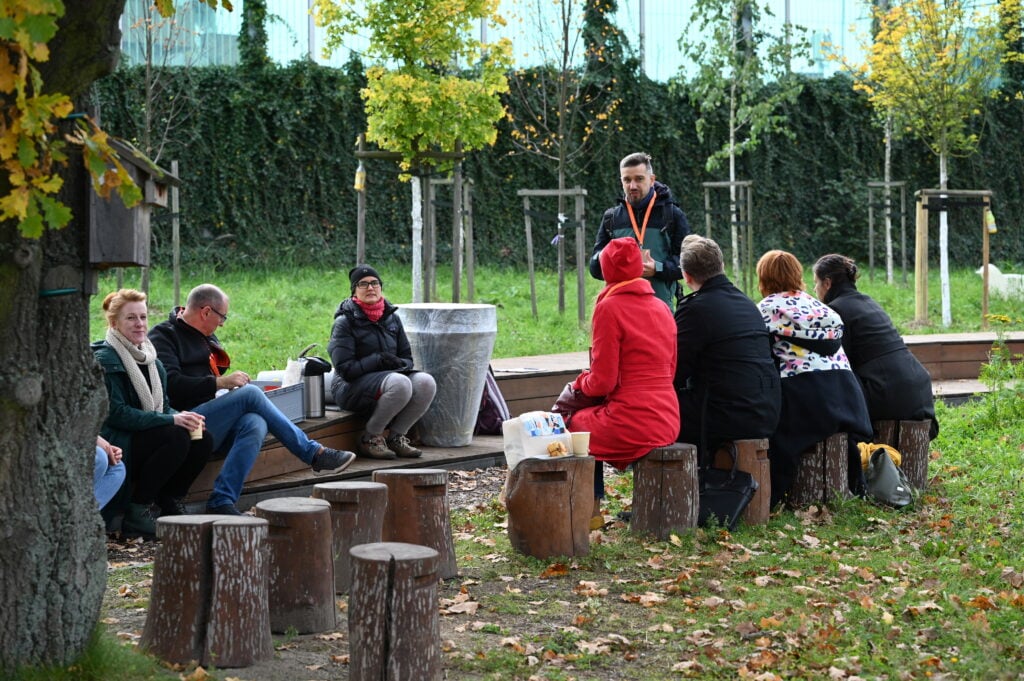
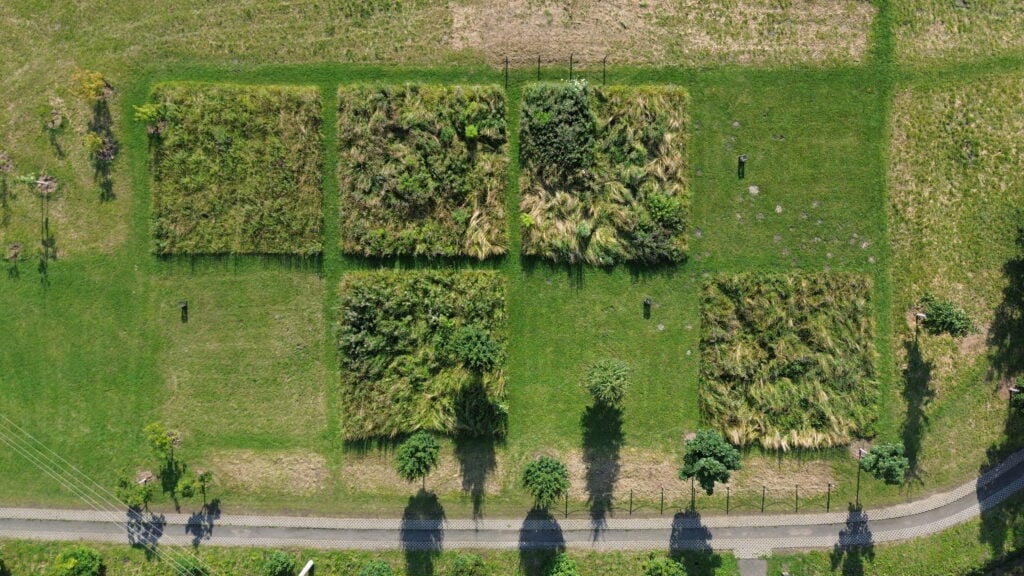
It began as a biological question. Mowing grass too often damages biodiversity, but so, biologists suspected, does not mowing it at all. To find out what actually works, researchers set up 72 test plots across the Jagiellonian’s Third Campus, applying different mowing regimes, some cut several times a year, some once, some left untouched for up to two years, and tracked insects, ticks, soil organisms, temperature and moisture across every one.
What made it a Living Lab project rather than a conventional field study was who else was in the room. Alongside the biologists sat researchers from management and journalism, and around the table came local gardeners, gardeningcompanies, residents, and the city council staff responsible for Kraków’s green spaces. There were workshops, focus groups, and guided walks with school groups, all built around one blunt observation: many people mow constantly because they are “scared” of what happens if they don’t. The team wanted to understand that fear rather than dismiss it.
The findings landed on the side of moderation: mowing too rarely lets the most aggressive, often non-native plants take over, starving out the insects and smaller species that depend on a mix of habitats. Rather than publish that conclusion and move on, the team turned it into a gamified educational web application, built with an IT company, that lets anyone experiment with different mowing regimes and watch the ecological consequences play out. An English-language version is available for wider use. That, more than the underlying biology, is what made the story travel: television, radio and online press picked it up, and links to the project reportedly reached websites with thousands of users and hundreds of comments from people encountering, for the first time, research that had existed in academic journals for years without an audience.
The lesson Beata draws from it is a methodological one as much as a scientific one. Rigorous findings on their own rarely change public behaviour; what moved people was seeing the trade-offs for themselves, on a tool built with the inclusion of the groups who would have to live with the recommendations. Whether the specific advice travels beyond Kraków is a separate question, and one she answers carefully. The mowing schedule itself holds up reasonably wellacross the same climate zone, but not in places where different plant species and vegetation change the calculation entirely. The stakeholder engagement model, though, is what she believes scales well anywhere.
Not every project lands so cleanly. One of CaLiLab’s four founding pilots, the inclusive leisure space designed for people with disabilities and other vulnerable groups, reached a finished prototype design and an agreed test site before it stalled.
“We had a formal agreement from the university to test on this particular spot, but the people who gave us this agreement, they were not aware of the situation,” Beata says. The situation was a protected species of butterfly living on that exact plot of land, one of the last places on campus where it survives. The team had to choose between the needs of the people the project was designed for and the habitat of a species none of them had planned around. “Everybody was right, actually,” Beata says. “We had to choose. We chose the nature.”
The project has never been built. It exists as a complete, tested design waiting for a site that doesn’t yet exist, with some hope that the city of Kraków might eventually take it forward. It’s a useful reminder that a Living Lab’s job isn’t to guarantee a happy ending, but to surface the real trade-offs before they become implemented full scale .
Ask her for a definition and she resists giving a tidy one. “I think the concept of the Living Lab cannot be defined in a simple way, as a kind of method,” she says. “I think it’s closer to an ecosystem, an organisational framework that organisesthe relations between knowledge and innovation development activities and the way different actors participate.” What holds every Living Lab together, in her view, is user orientation, real-life context, co-creation and innovation testing, the same core elements ENoLL itself uses to define the model.
She’s equally clear about when a Living Lab isn’t the right tool. If the goal is democratic, equal-footing research, action research alone may be enough. If the goal is simply developing a solution without deep scientific rigour, design thinking will do the job faster. Living Labs earn their complexity when a project needs all three at once: rigorous research, genuine participation, and a real plan for implementation, which is why her advice to anyone considering the path always starts with that question rather than with logistics.
The rest of her advice follows CaLiLab’s own experience. Don’t try to build a Living Lab alone; gather people who share the enthusiasm, the way she and her colleagues from two departments did four years ago. And decide early whether the Living Lab is meant to end with its founding project or to outlive it. CaLiLab knew from its first year that it wanted to survive past its original funding, which is exactly why it invested early in a clear strategy rather than waiting to see how things went.
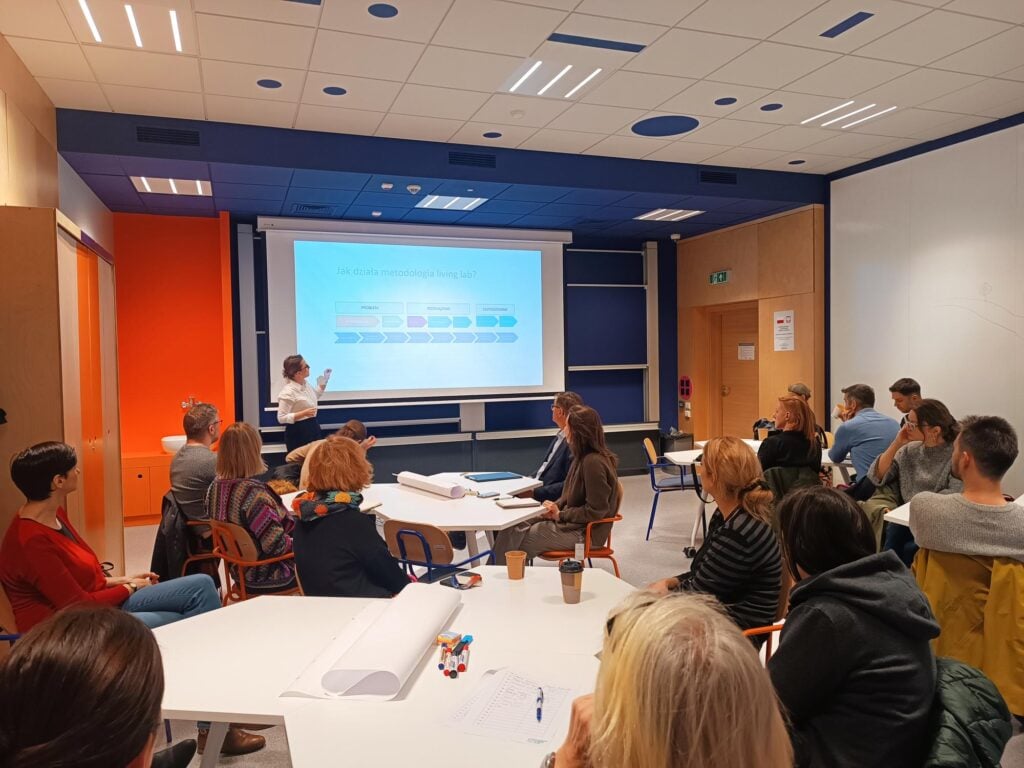
That conviction from Turin turned into something concrete early on. Rather than build a survival strategy alone, the team invited ENoLL for a three-day participatory workshop in CaLiLab’s first year, with two ENoLL facilitators guiding around 20 people from across the university through the process of turning scattered ideas into an actual plan.
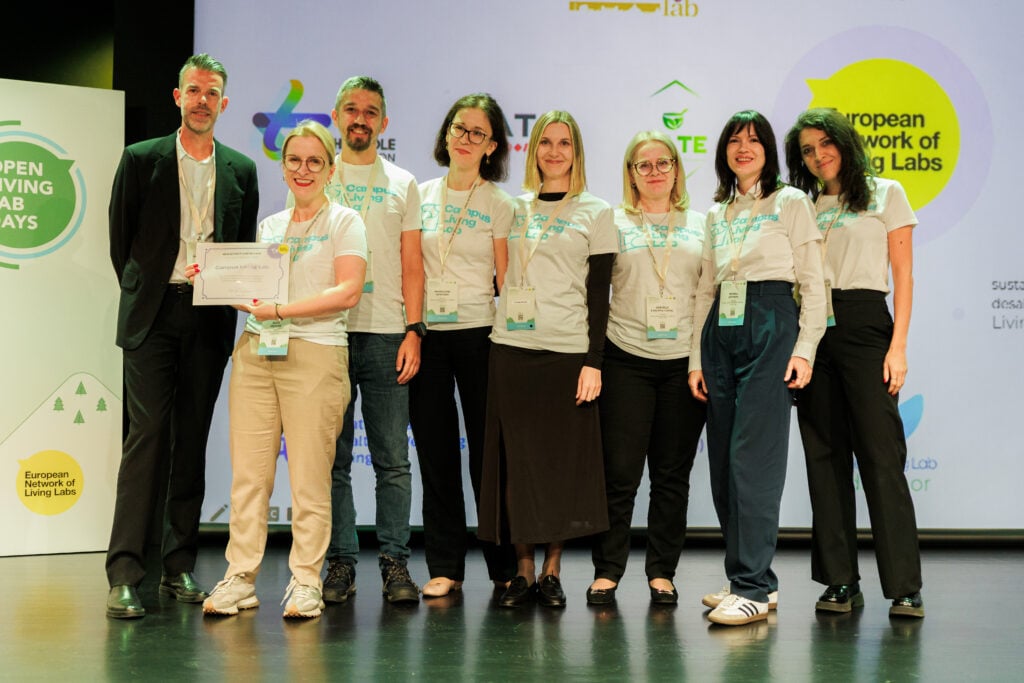
Certification came later, and more deliberately. After roughly two years of operation, the team applied, understanding it less as a badge and more as a structured way to see where they stood. The first attempt resulted in Accepted to Grow Member status rather than full certification, along with a detailed feedback report on where to improve. The team spent the following year working through that feedback systematically, then reapplied and earned Adherent Member status, the recognition CaLiLab holds today.
Asked what doesn’t usually make it into stories like this one, Beata doesn’t hesitate. Coordinating a transdisciplinary Living Lab inside a large, hierarchical university structure is genuinely difficult, and researchers used to leading their own work aren’t always ready to step back and share that role with people outside the university. It is also very difficult to balance the exceptionally high expectations in teaching and research with engagement and collaboration with external stakeholders.
The bigger issue is money. “Being dependent on project funding, I think this is the simplest way to go into starving cycles, like with NGOs,” she says. The constant search for the next grant is exhausting for everyone involved, and it’s a large part of why building a permanent research centre mattered so much to CaLiLab’s team.
Business is the other persistent gap. Of the quintuple helix partners, industry is the one CaLiLab still struggles to bring in consistently, unsurprising for a university with no technical faculty. There is at least one clear exception: a completed project developed a new type of soil for green roofs, with a business partner supplying materials in exchange for early access to the research. The team has since filed two patent applications and won a gold medal at an innovation fair for the concept, with hopes of eventually scaling it onto public and private rooftops alike. It’s the kind of result Beata points to when making the case, inside a mostly non-technical university, that industry partnerships are worth the extra effort to secure.
What matters more than centuries of academic prestige is serving people and nature. It is that same instinct that keeps Beata and her colleagues testing ideas on their own campus rather than settling them from a lecture hall. Six hundred and fifty years later, the Jagiellonian is still finding new ways to be, quite literally, a place that serves.
Interview conducted by Andrada Barață, Head of Communications at the European Network of Living Labs (ENoLL), with Beata Jałocha, Associate Professor and Campus Living Lab lead at the Jagiellonian University.
Stay connected and inspired! Subscribe to our newsletter for the latest updates, insights, and innovations from our global community of Living Labs.