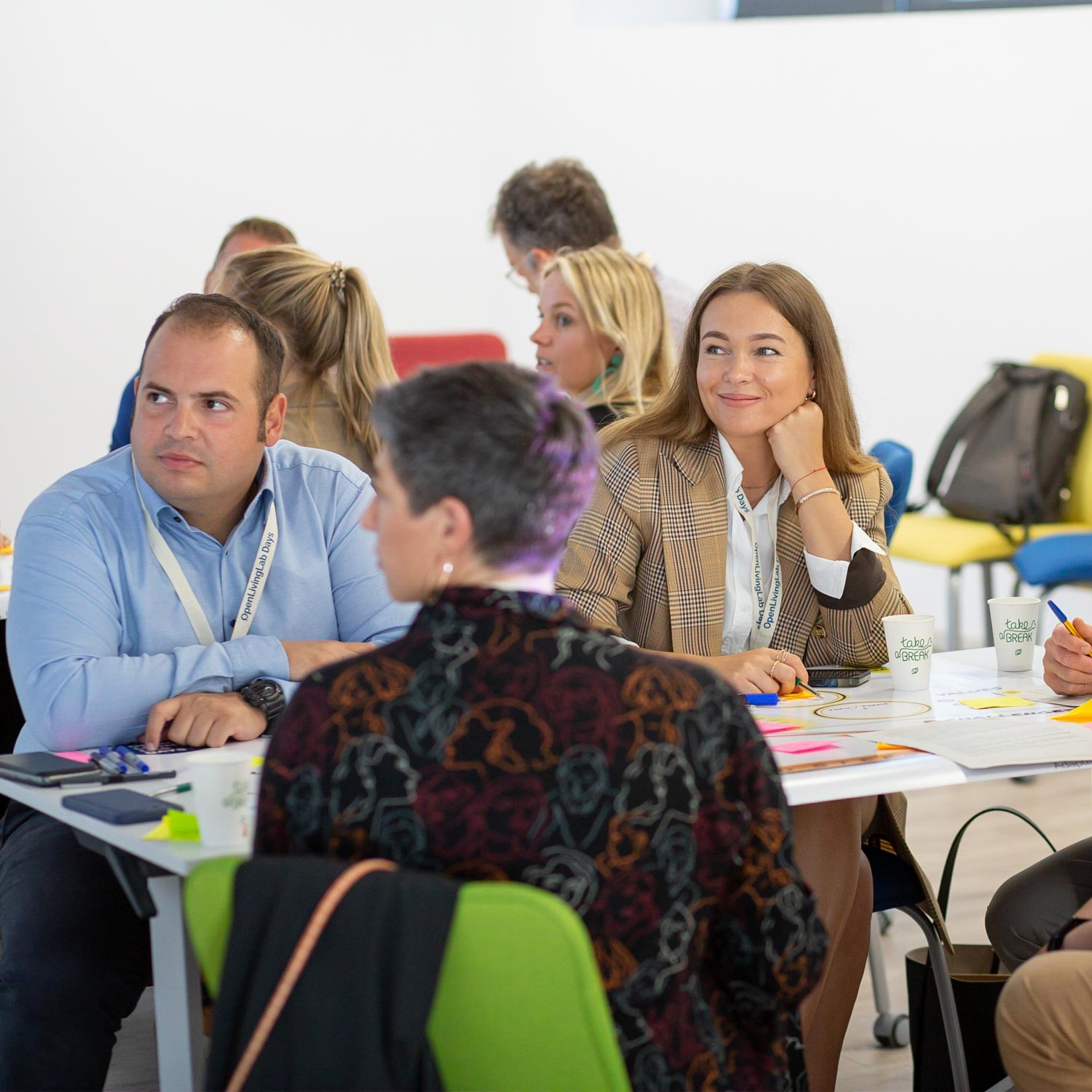
Bringing together the Culture & Creativity and Regenerative Tourism & Placemaking Working Groups, this interactive session explored how arts, culture and regenerative approaches can contribute to place-based transformation. Inspired by the artistic methodology Issue Wrestling, developed by artist Natasha Taylor, participants engaged in facilitated debates around provocative statements, physically positioning themselves to express different perspectives.
The session aimed to make visible the tensions and sometimes conflicting visions that emerge around place transformation, identity, inclusion and sustainability. Rather than seeking consensus, it created space for diverse viewpoints to coexist and encouraged collective reflection on what it means to transform places in ways that are sustainable, inclusive, regenerative and meaningful.
Insights, Outcomes and Next Steps
Key Discussions and Insights
Using the Issue Wrestling format, developed by artist Natasha Taylor, the session placed provocative statements on the table and invited participants to take a physical position. The discussion drew on climate adaptation, citizen participation, landscape, public spaces and the New European Bauhaus (NEB) as a concrete case of how places can be left better than they were found, and on the transformation of Rijnhaven in Rotterdam as a case of a city in constant renewal. Several themes, and the tensions between them, structured the exchange.
A city in transformation: Rijnhaven, Rotterdam. The Regenerative Tourism & Placemaking Working Group brought in an adapted version of Issue Wrestling for the small stage, co-designed with artist Natasha Taylor, who developed the method. It tackled the theme of endless renewal and opaque socio-spatial transformation in cities, using a cast of place-based characters informed by Rijnhaven, a Rotterdam harbour area in transformation. In the face-off, the Tower of Power battled the Flotsam of Gentrification, while red-taped bureaucrats and slippery fish tried to navigate the shifting terrain of development.
The New European Bauhaus as a shared quality test. The NEB values (beautiful, sustainable, together) and its four axes (reconnecting with nature, regaining a sense of belonging, prioritising the places and people that need it most, and long-term life-cycle thinking) were discussed as a way to judge regeneration by how a place looks, feels and includes people, and not only by how it performs technically.
Art and culture as environmental drivers. Arts and culture are not decoration: Living Labs engage stakeholders through arts, culture and creative entrepreneurship, and tests regreening first with pop-up, temporary nature-based solutions co-created with the creative sector and volunteers. Creative practice acts as a low-risk way to prototype change, to make environmental issues visible and tangible, and to connect them with local identity, heritage and the area’s planned cultural role.
Citizen participation: co-designers, not only users. Climate shelters and green spaces are aimed at older people, children, people with chronic illness and energy-poor households, yet the shelter study itself was expert-prepared and resident input is still to be documented. The discussion highlighted the need to involve older people’s and neighbourhood associations, schools and cultural venues as co-designers, and to keep a small, representative core group.
Policy participation and multi-level governance. The question raised is how local experiments can feed into institutions so that they do not remain isolated pilots, and how residents can take part in policy design and not only in activities.
Tensions made visible. Typical tensions for debate include: regreening and cultural investment versus the identity of a former industrial area; beauty versus function; expert-led versus resident-led design; quick pop-up experiments versus long-term maintenance; heritage and local stories versus standardised solutions; and visible, iconic development versus the opaque processes of transformation behind it. The format kept these views side by side without forcing consensus.
Main Outcomes and Takeaways
Use the NEB as a practical checklist. Before each pilot or intervention, ask whether the place is beautiful (one people want to use), sustainable (low-carbon and biodiversity-friendly) and together (co-designed and open to all).
Let culture and creativity lead experimentation. Pop-up, temporary and arts-based interventions allow places to be tested, discussed and adjusted with residents before permanent works, and use local stories and heritage to avoid standardised design.
Make citizen participation visible and consequential. Map stakeholders by influence and interest, give a written reason for each choice, run co-design workshops with groups that are rarely heard, and document how their input changes decisions.
Connect experiments to policy from the start. Define evaluation criteria before each pilot, link them to impact indicators, assign a municipal owner and budget line to those that work, and check the legal basis (for example, opening protocols or ordinances) as part of the design.
Plan for life after the project. Living labs rarely outlast their funding. Anchor stakeholders, a municipal commitment and a route from pilot to institutional routine from the beginning.
Use play and role-play to open up critical dialogue. Issue Wrestling, the artistic method developed by Natasha Taylor, is engagement-led: giving the forces at work in a place a character of their own makes power, interests and conflicting visions easier to talk about, in a playful and accessible way. The format can be adapted to a small stage and to the specific story of a place.
What the wider Living Lab community can take away: regeneration is not only an environmental or technical process but also a cultural and social one; small and medium-sized municipalities can build credible pathways by reusing existing diagnoses, public spaces and funded projects; and tensions between identity, inclusion and sustainability are best made visible and worked through together rather than avoided.
What’s Next?
Put the NEB checklist to use. Test the beautiful–sustainable–together checklist in new pilots and compare results across Living Labs in the Working Groups.
Document art-based and participatory methods. Gather examples of how arts, culture and formats such as Issue Wrestling by artist Natasha Taylor make tensions visible and help co-design regenerative places, including place-specific adaptations such as the Rijnhaven version, which other Living Labs can reuse for their own cities in transformation.
Strengthen citizen and policy participation. Set up co-design groups with older people, neighbourhood associations and schools, and share how resident input is turned into policy and planning decisions.
Shared indicators. Develop a small set of comparable indicators covering cultural and social co-benefits (sense of belonging, use by vulnerable groups, resident satisfaction) alongside environmental ones.
Connect to wider networks. Share the approach through the NEB community, and ENoLL, and exchange experiences with other Living Labs in the Working Groups.
Open questions. How can the aesthetic and cultural value of places be measured? How can artistic interventions become permanent, funded practice? How can regenerative tourism and placemaking benefit residents first? How can living labs continue beyond project funding
Author(s):
Jokin Garatea (Culture & Creativity Working Group)
Iris Kerst (Regenerative Tourism & Placemaking Working Group)
Donagh Horgan (Regenerative Tourism & Placemaking Working Group)