What happens when a think tank decides the future is too important to leave to experts alone? For La Fabrique du Futur, an ENoLL member based in France, the answer has been two decades of co-creation, collective intelligence, and a growing conviction that Living Labs must evolve or risk falling short of the challenges ahead. Their most ambitious answer to that challenge: a new model of distributed Living Labs capable of tackling planetary problems that no single lab could face alone.
La Fabrique du Futur, which translates as “The Factory of the Future”, was founded in 2006 by Eric Seulliet. At its core was a simple but powerful observation: the people most passionate about technological innovation often lacked awareness of sustainable development, while those championing ecology frequently harboured a distrust of technology. As a result, the two worlds rarely met.
“There is no reason to have this gap between technological innovation and social innovation,” Eric explains. From the very beginning, therefore, La Fabrique du Futur set out to bridge it. To do so effectively, the organisation quickly understood it needed to work with people, not just for them. Co-creation and collaborative innovation became the DNA of the project.
It was precisely this orientation that, in 2006, led Eric to discover ENoLL, founded that same year. Reading about what a Living Lab actually was, he immediately recognised a kindred spirit. “I thought La Fabrique du Futur should be a Living Lab, because we also are in co-creation,” he recalls. “This is how the story began.”
In 2008, La Fabrique du Futur joined ENoLL under the name “3D Living Innovation”, as it reflected thei initial focus on virtual worlds and immersive technologies. Over time, as the scope of the work broadened, the Living Lab naturally evolved into the more encompassing identity of La Fabrique du Futur.
La Fabrique du Futur is, by its own definition, a virtual Living Lab. It has no physical third place, no large team, and no heavy institutional infrastructure. This is not a limitation but a deliberate posture. “We are more in the promotion of the Living Lab spirit,” Eric notes. The organisation has consistently worked through partnerships, cross-membership with other associations, and a growing ecosystem of collaborators across sectors.
La Fabrique du Futur was a co-founder of France Living Labs and later of the Francophone Living Labs network, which brought together labs from France, Belgium, Switzerland, and Canada. Additionally, the organisation has helped establish Living Labs in Normandy and even in Reunion Island in the Indian Ocean, in partnership with the University of Reunion.
What ties these efforts together is a consistent belief: that innovation must be rooted in shared purpose and that the future is something to be built collectively, not merely predicted.
Ask Eric to define a Living Lab and his answer is both simple and far-reaching. “A Living Lab is an open ecosystem with users at the centre,” he says. “Because they are the heart of the Living Lab.”
Importantly, he challenges the adequacy of the word “user” itself. The person at the centre is not merely a consumer or test subject but a citizen, a worker, a student, a community member. What distinguishes a Living Lab from other forms of innovation is precisely this: the individual, in their full complexity, is not a means to an end but the reason the lab exists. Around that individual stands a circle of diversified stakeholders, including researchers, companies, public agencies, and communities, united by a common goal and equipped with appropriate tools and methods.
The values Eric identifies as essential, trust, authenticity, engagement, and shared purpose, are not incidental. They are what make sustained collaboration possible. “If you want people to work together, you must trust one another,” he reflects. This conviction shapes everything La Fabrique du Futur has built since, from its networked model of collaboration to its most ambitious current project.
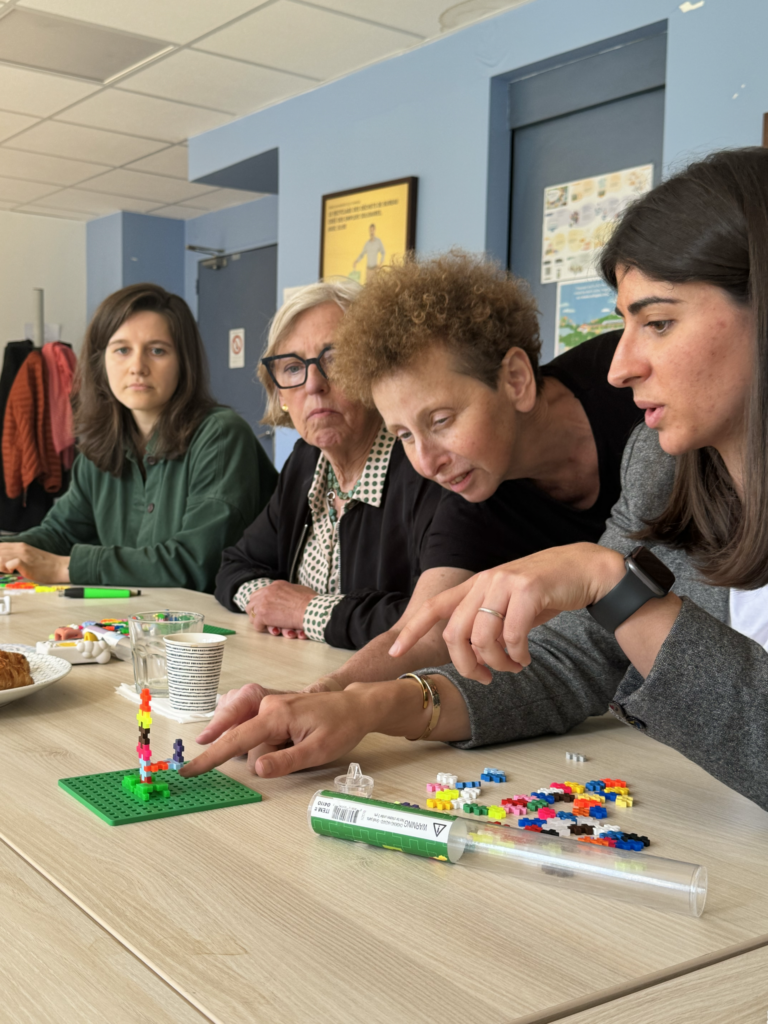
Perhaps the most distinctive contribution of La Fabrique du Futur to the Living Lab world is its work on the concept of Distributed Living Labs (DLLs). This is not simply a metaphor for working remotely. It is, rather, a fundamental rethinking of how Living Labs can tackle the large-scale, boundary-crossing challenges of our time.
“A Living Lab works locally,” Eric explains. “But the outreach is quite limited. So the concept we want to promote is Distributed Living Labs.” The idea is to link Living Labs from different parts of the world around a shared global challenge such as climate change or public health. In doing so, each lab contributes its local knowledge and context, while collectively the network generates insights and solutions that none could reach alone.
This vision draws directly on the concept of Decentralised Autonomous Organisations (DAOs), borrowed from the blockchain world. In a DAO, there is no central authority. Each node in the network holds equal power and can act autonomously, yet all are aligned around common rules and shared goals. Applied to Living Labs, this structure offers something genuinely new: democratic, distributed governance for collective innovation.
“In a blockchain network, each point has the same power,” Eric explains. “It’s more democratic. It’s more flat. It’s more flexible.” For Living Labs tackling wicked problems, from climate change to migration to urban inequality, this architecture could be transformative. Moreover, the model also addresses one of the most persistent challenges in collaborative innovation: the question of intellectual property and the fair recognition of contributions. Blockchain’s traceability functions offer a way to track who has contributed what, ensuring that no participant’s input disappears into the collective without acknowledgement.
This research has been formalised in a co-authored essay developed with Living Lab researchers Hank Kune, Valérie Lehmann, and Cathy Zadra-Veil, which explores how a network of distributed Living Labs could become an effective instrument for addressing systemic, planetary challenges. The paper asks, among other questions: who serves as challenge owner in such a network? How is governance maintained democratically? And how do diverse labs with different languages, cultures, and institutions develop the trust needed to act together?
These are not abstract questions. They are the practical frontier of where La Fabrique du Futur is working now, and the organisation has begun building concrete vehicles for it. The International Network of Distributed Living Labs (IPLL) aims to formalisecooperation between territories working on shared challenges. The Living Lab Fresco, a facilitation tool, helps stakeholders build a common understanding of what the Living Lab approach actually involves before collaboration begins. And HILL (Hybrid Immersive Living Lab) explores how immersive environments can blend physical and virtual participation, extending the reach of a Living Lab beyond whoever happens to be in the room.
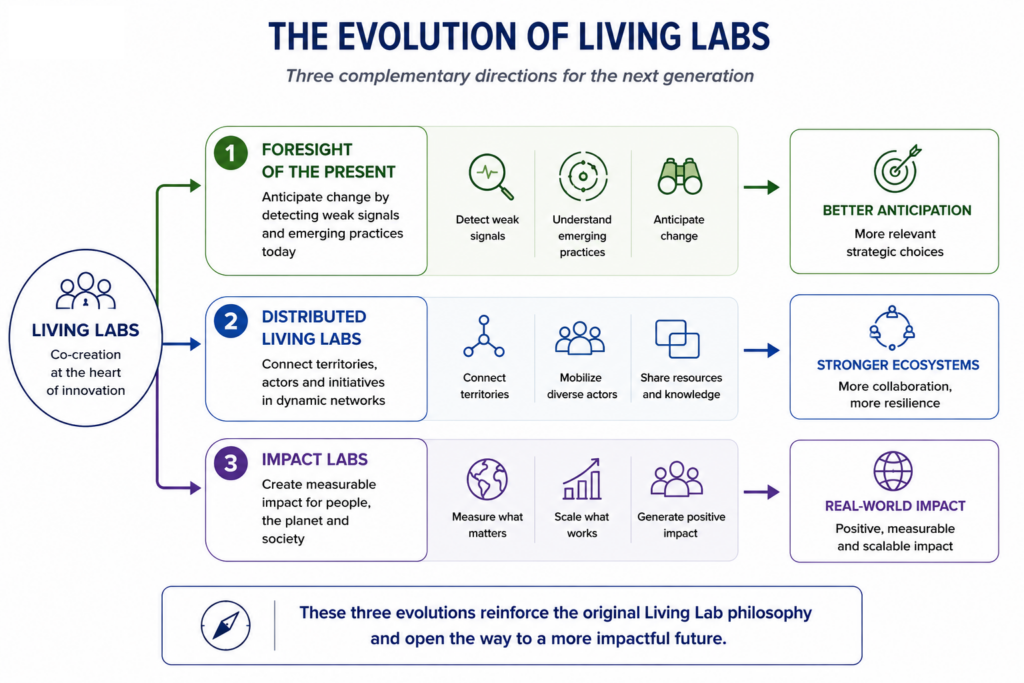
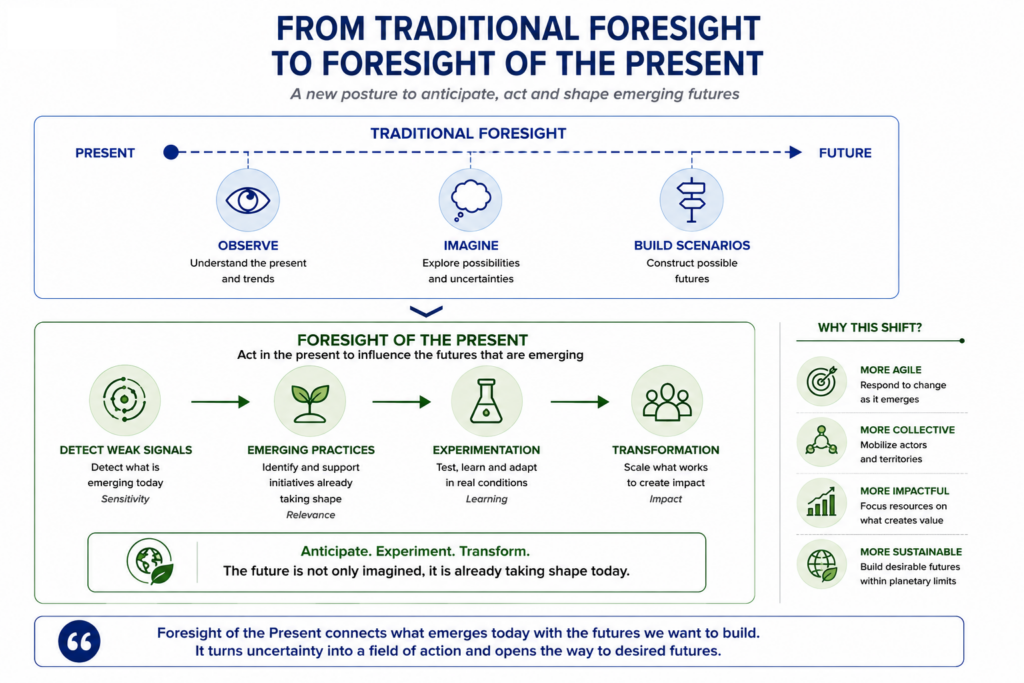
Alongside the distributed Living Lab concept, La Fabrique du Futur has developed a strong focus on foresight, specifically a participatory approach to imagining and building desirable futures. In a world characterised by rapid change and deep uncertainty, Eric argues that traditional scenario-planning methods are no longer sufficient.
“What we call VUCA,” he notes, referring to the volatility, uncertainty, complexity, and ambiguity of the contemporary world, “makes it very difficult to make scenarios.” Instead, La Fabrique du Futur advocates for a collaborative approach to futures thinking. “The best way to create the future is to create it in a collaborative way,” Eric says. “The future is what tomorrow will be, and you have to work on it today, collaboratively.”
The organisation has given this approach a name: Foresight of the Present. Rather than starting from distant, speculative futures, it begins by observing the transformations already under way, in artificial intelligence, in digital twins, in the weak signals that are multiplying faster than ever, and asks what they mean before they become dominant.
In this sense, Living Labs are ideal ecosystems for foresight work. They bring together diverse people around shared goals, generate knowledge through real-world experimentation, and are structured to sustain engagement over time. La Fabrique du Futur has already introduced foresight thinking into the ENoLL community, notably a Deep Dive session co-organised with ENoLL in Paris in May 2024 on the theme of foresight for Living Labs, based on the “Fresco of the Future” serious game.
From this perspective, the challenge is not simply to imagine possible futures, but to develop a way of deciding which futures are worth exploring and supporting. This led La Fabrique du Futur to develop the concept of 4D Futures (i.e. Futures with four dimensions: ”Discernible, Durable, Disruptive and Desirable”, a framework designed to look at emerging futures through complementary dimensions.
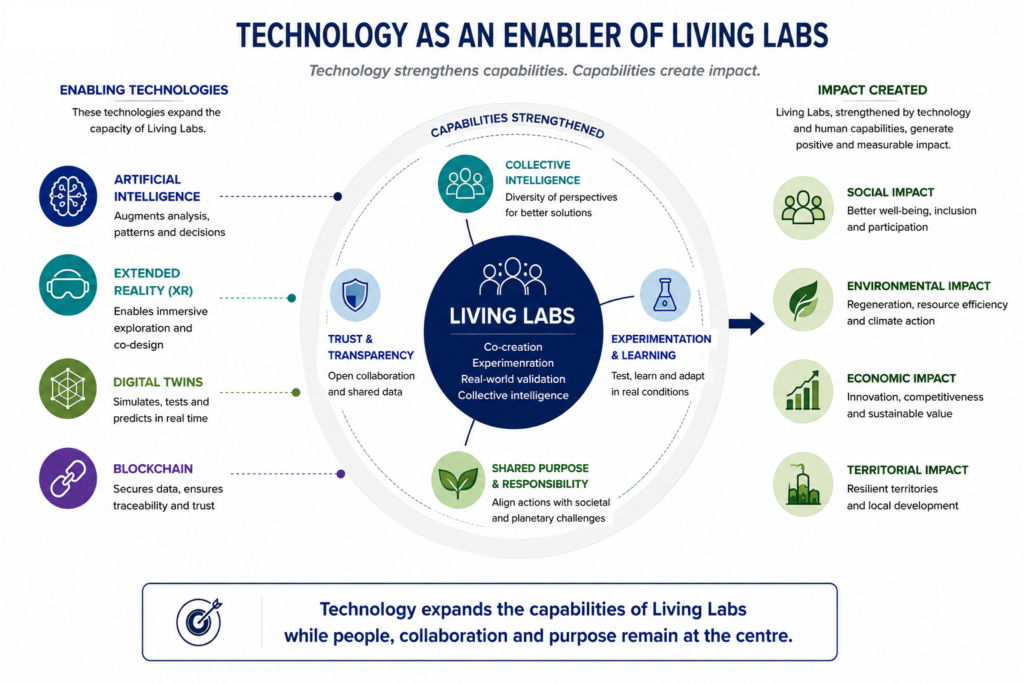
True to its “Techs for Good” philosophy, La Fabrique du Futur has consistently explored emerging technologies not as ends in themselves, but as means of enabling collaboration, traceability, and social impact.
The most recent expression of this is the Unyra Community platform, a digital space designed to support entrepreneurial projects with genuine social utility. La Fabrique du Futur has become a co-founder of the platform, which integrates blockchain for transparent contribution-tracking, DAO governance for decentralised decision-making, and artificial intelligence to support project development and visibility. For small organisations and citizen innovators alike, Unyra Community offers infrastructure for collective innovation that was previously available only to large institutions. It is, in many ways, the distributed Living Lab spirit made operational.
Similarly, La Fabrique du Futur is working on a distributed academic chair in partnership with several universities, focused on future literacy, the capacity to think consciously and creatively about the future. The application for this chair will soon be submitted to UNESCO in order to join its Future Literacy Network. Like the DLL model itself, this chair is designed as a network with multiple points of entry, rather than a single centralised institution. Together, these initiatives reflect a broader ambition: to build tools and structures that allow any community, anywhere in the ENoLL network and beyond, to participate meaningfully in shaping what comes next.
La Fabrique du Futur is, by conventional measures, a small organisation. It has roughly 40 official members, a lean governance structure, and limited financial resources. Yet its intellectual ambitions are anything but small, and its network reach continues to grow.
For instance, they have increasingly focused on the orchestration of multi-stakeholder alliances. In their view, one of the major challenges of our time is not the lack of innovative solutions, but our collective ability to connect initiatives, actors and resources in order to achieve systemic impact. There have recently been several major advances towards this objective: the creation of their collective brand “Ecosystem Fabrique du Futur” to serve as a rallying symbol for impact makers that they call “the builders of the future”; the integration within their ecosystem of the Act For Global Impact platform; and the co-development of ORYSS, a future European experimentation and deployment infrastructure bringing together offshore laboratories, Living Labs and pilot territories to accelerate ecological, technological and societal transitions.
ORYSS can be read two ways at once. It is a concrete implementation of the Distributed Living Labs vision, but it also points to something beyond it: a shift in how success itself gets measured. Rather than counting projects launched, ORYSS is designed to orchestrate collaboration around shared societal objectives and evaluate progress through tangible environmental, social and economic outcomes. La Fabrique du Futur has started referring to this orientation as an Impact Lab, a Living Lab whose purpose has shifted from facilitating innovation to demonstrating its measurable effect.
ENoLL membership has been central to extending that reach internationally. The relationships built through the network have opened doors to exchanges of good practice, invitations to the OpenLivingLab Days, and the possibility of future European project partnerships. La Fabrique du Futur is also looking more actively at collaborative Horizon funding applications, building the capacity to pursue projects at the scale its ambitions require.
Eric’s message to the Living Lab community is both a suggestion and a challenge: bring foresight thinking into the heart of the work. “Today, Living Labs are working on very down-to-earth problems,” he observes. “That is good, I am not criticising. But if you really want to change the world, you must project yourself into the future. You must say: in 10 years, in 20 years, let’s build this.”
It is a call to look up from the immediate and ask what kind of world Living Labs are ultimately trying to create. For La Fabrique du Futur, that question has never stopped being the first one.
The future, as they see it, is neither predicted nor imposed. It is imagined, explored and built together.
Interview conducted by Andrada Barată, Head of Communications at the European Network of Living Labs (ENoLL), with Eric Seulliet, CEO La Fabrique du Futur
Stay connected and inspired! Subscribe to our newsletter for the latest updates, insights, and innovations from our global community of Living Labs.