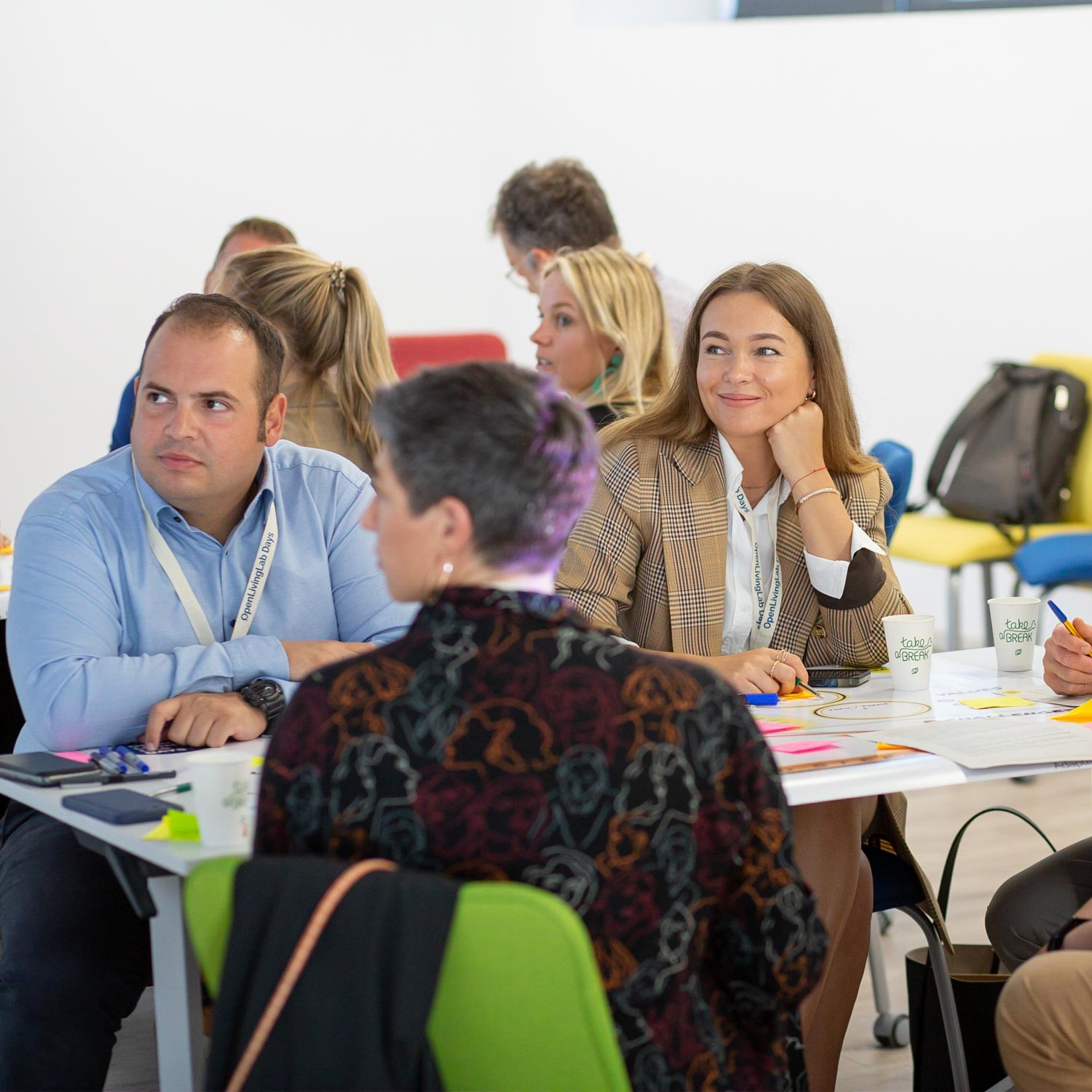

Keynote and Interactive session at the Design Days 2012 in Brussels on case studies presented by Tuija Hirvikoski, PhD Laurea, Finland, Director, European Network of Living Labs, council member
Keynote and Interactive session at the Design Days 2012 in Brussels on case studies presented by Tuija Hirvikoski, PhD Laurea, Finland, Director, European Network of Living Labs, council member
Today, a growing number of cities and regions are using design to peer into large-scale systems and developing strategies that enable us to create transformative societal innovation. “Strategic design is a way to specify the intentions that we want to accomplish and steward efforts towards the realisation of those aims.”[1]
The growing enthusiasm in applying design thinking and methods to public and social policy challenges may be, among other reasons, because design thinking catalyses people to innovate and see opportunities in a new way. With the help of design methods, we can create a virtuous circle of learning whilst methods like visualisation may help us to share abstract ideas. Moreover, they help us to spot the promising connections between things or they enable us to escape the constraints dominating bureaucracies and to avoid pitfalls of traditional boarders. By quickly developing multiple perspectives and integrating strategic intent with execution, strategic design advances society’s ability to work in integrated fashion with complex issues in dynamic context. Design methods can help governments and public authorities, who traditionally spend billions on research and development, to invest in themselves by developing new ways of tackling wicked problems and creating public innovation. Best of all, strategic design allows people to act while the government facilitates.
This presentation discusses the abstract notions of Service Design and Strategic Design, in conjunction with real life experiences from the European Network of Living Labs (ENoLL) community, mainly from Finland, who is moving towards a human-oriented society, and its capital Helsinki, the World Design Capital 2012 and from Barcelona, the Mobil World Capital[2] 2012.
By “zooming in” and “zooming out”, the presentation examines the micro-level service design examples and availability of new consumer choices as affected by the more macro-level context. This is because the accessibility and attractiveness of new services are shaped and enabled in regional and global innovation ecosystems as well as by national and EU innovation policy. In ENoLL, we trust that strategic design around societal challenges could help Europe to create new global lead markets with the help of user-driven open ecosystems. The open ecosystem approach encourages regions and cities to engage firms, public agencies, academia, even local schools and interested laymen in a strategic dialogue and collective action to find new possibilities and to design new solutions to help develop globally competitive but regionally anchored firms, markets and industries.
Regions and cities are places for life. There, people and organisations encounter and solve major societal challenges. The most critical challenges we face are those which are most interconnected or systemic in nature. Therefore, today’s challenge lies in our capacity to rewrite assumptions inherited from previous eras of prosperity and to create ways of collaborating across traditional social and knowledge borders and keeping dialogue alive in order to actively work towards common goals. The Synergise Finland development project (Sitra) is an example of how these elements where present when addressing the concept of new work and the idea of new demography. Immediate democracy is based on increased openness and the flexibility of administration; it means that operations are spontaneously introduced by the public. The New Democracy forum experimented with participatory budgeting, crows sourcing of information requests and a social hub, where people can meet and work together.[3]
In order to cope in the complex and rapidly changing environments, innovative cities and regions as smart societies apply holistic and systemic thinking, they benefit from the proximity of the social innovation community by applying on the open, user-driven innovation: “When they have a problem, they ask everyone”.[4] They know that people are willing to be of service, so they inspire individuals to contribute to the innovation processes Due to the fact that many of today’s problems are structural in nature, with little or no precedent, their policy and strategic design is based on systemic thinking, it is human centric and it applies collective and collaborative RDI and design. – Whilst, in Finland, these principles have been applied successfully in the Innovation policy, in the more micro level the Higher education institutions have supported these policy aims in practice by integrating the RDI with learning. Laurea’s Service Design and Innovation and Aalto Design Factory are great examples on how both design and co-creation works at all levels.
In addition, cities and regions should view themselves as places and engines for globally competitive and open, ecosystem-based, human-centric RDI in real-life contexts, such as living laboratories that engage people. When solving societal challenges, we co-design, experiment and pilot new services, technologies and businesses in the ecosystems. Cities and regions, as rural or urban Living Laboratories, are places where distributed leadership based on trust and shared responsibilities among firms, public authorities, academia and people help firms and people to design and produce new services. The way Living Lab thinking has been applied by the city of Barcelona or how the Consciousness Academy in Friesland puts the citizen into the centre of the development policy, are great examples of citizen empowerment. Similarly, the city of Oulu is successfully renewing their social and health care system in close collaboration with the citizens.
By “zooming out,” we can reflect on how Europe may create new global lead markets and globally competitive RDI with entrepreneurial strategies around societal challenges, as Professor Seija Kulkki encourages us to do. Regions and cities can help to develop globally competitive and regionally anchored firms, markets and industries. “In regional ecosystems or living laboratories, we can create and test the new distributed structures, value creation and business models, or the renewed production and consumption patterns of the emerging new service or business ecosystems, new markets or new industries.”[5] Innovative regional policy, open government policy[i], policy and research integration, and decisions to support the bottom-up development, to provide good education or to apply the public pre-commercial procurement will help the transformative innovation to emerge.
Finally, by “zoom in,” we encourage individual civil servants, politicians, entrepreneurs, designers, students and citizens to trust their creativity and share their ideas in order to start the collective innovation and transformation process. We should remember that “One’s ability to generate innovative ideas is not merely a function of mind, but also a function of behaviour, which means that ‘if we can change our behaviours, we can improve our creative impact’.”[6] Researchers have identified five discovery skills that distinguish innovative entrepreneurs and executives from ordinary managers. We can all train and engage these actions—questioning, observing, networking, and experimenting to trigger associational thinking to deliver new businesses, products, services, processes and societal transformation. Because, in the end, it is up to us, the life’s every day individual heroes, to make the Butterfly Effect possible for the societal transformation for better life.
Design is a key discipline and activity that brings ideas to the market, as has been recognized by the Innovation Union, one of Europe 2020’s flagships. In line with this initiative, the European Commission has launched a European Design Innovation Initiative in order to raise awareness and enhance the role of design in Europe.
Design Days will form a regional input to these initiatives by unifying stakeholders active in design from different regions in Europe. Moreover, Design Days adopts a cross-sectorial stance by involving not only enterprises but representatives from the world of education and service.
This multidisciplinary approach may lead to new and innovative solutions to everyday challenges, thus highlighting the role design plays today and in the future.
[1] In_Studio-Recipes_for_Systemic_Change
[2] http://mobileworldcapital.com/
[3] Synergise Finland forum New democracy: www.sitra.fi/uusi-demokratia
The Ominvoimin report (only available in Finnish): http://ominvoimin.com/ominvoimin-raportti-valmistui/
[4] http://www.nytimes.com/2008/07/22/science/22inno.html?_r=2&pagewanted=all
[5] Kulkki (2011) Science and Society, Pan European Networks: Science and Technology, November 2011 issue
Kulkki (2012) Getting Competitive, Pan European Networks: Science and Technology, March 2012, issue 02, pages 28-31
[6] http://innovatorsdna.com/books-on-innovation/the-innovators-dna/
[i] http://www.sciencebusiness.net/Assets/27d0282a-3275-4f02-8a3c-b93c2815208c.pdf
Stay connected and inspired! Subscribe to our newsletter for the latest updates, insights, and innovations from our global community of Living Labs.